
Business Management
Being Too Close
When Helping Too Much Hurts Growth
As a business mentor, my role is to guide, challenge, and support my clients so they…



Firstly, I want to explain that I am a steadfast believer in the principles of Equality, the power of Diversity and the value of Inclusion in our society and workplaces. I have been a social justice campaigner for over 35 years and an EDI trainer for 20. Why do I need to start by asserting this? Because what I’m about to put to you comes uncomfortably close (at least, at the beginning) to the arguments of those politicians who have been attacking EDI for several years.
The right-wing assault began in earnest under Sunak, led from the highest levels of government, through institutions like the Civil Service, down to local councils. The need to cut budgets gave the ‘anti-woke’ crew exactly what they needed to get rid of all these ‘ridiculous EDI jobs’ (Daily Mail). The winds of reaction blowing across the Atlantic have transformed into a hurricane since Trump’s election for a second term, further emboldening those who oppose all this ‘PC nonsense’. The Labour Government has taken some steps to resist, especially with the new Employment Rights Act but its commitment to progress seems far from reliable and now Reform threatens that it will repeal the Equality Act if it is elected.
And this is the uncomfortable bit for me – one of their main arguments is that the whole EDI project has been a giant waste of money that has done little to achieve its goal of improving lives. And, unfortunately, I am forced to agree on this point, even though I am coming at it from the opposite end of the political spectrum.
I’ve put together this graphic of the experiences of some ‘marginalised’ people in the UK in the 2020’s, focusing on key issues that determine quality of life. Of course, statistics can be used to ‘prove’ all sorts of conclusions, I could have chosen other characteristics and figures, but I hope that the range of issues here and the reliability of sources will help paint a realistic picture of our social progress towards equity. There have been some positive changes, but I think we must conclude that over the last 61 years (since the 1965 Race Relations Act, the first piece of Equalities legislation), progress has been painfully slow and has even begun to reverse in some respects.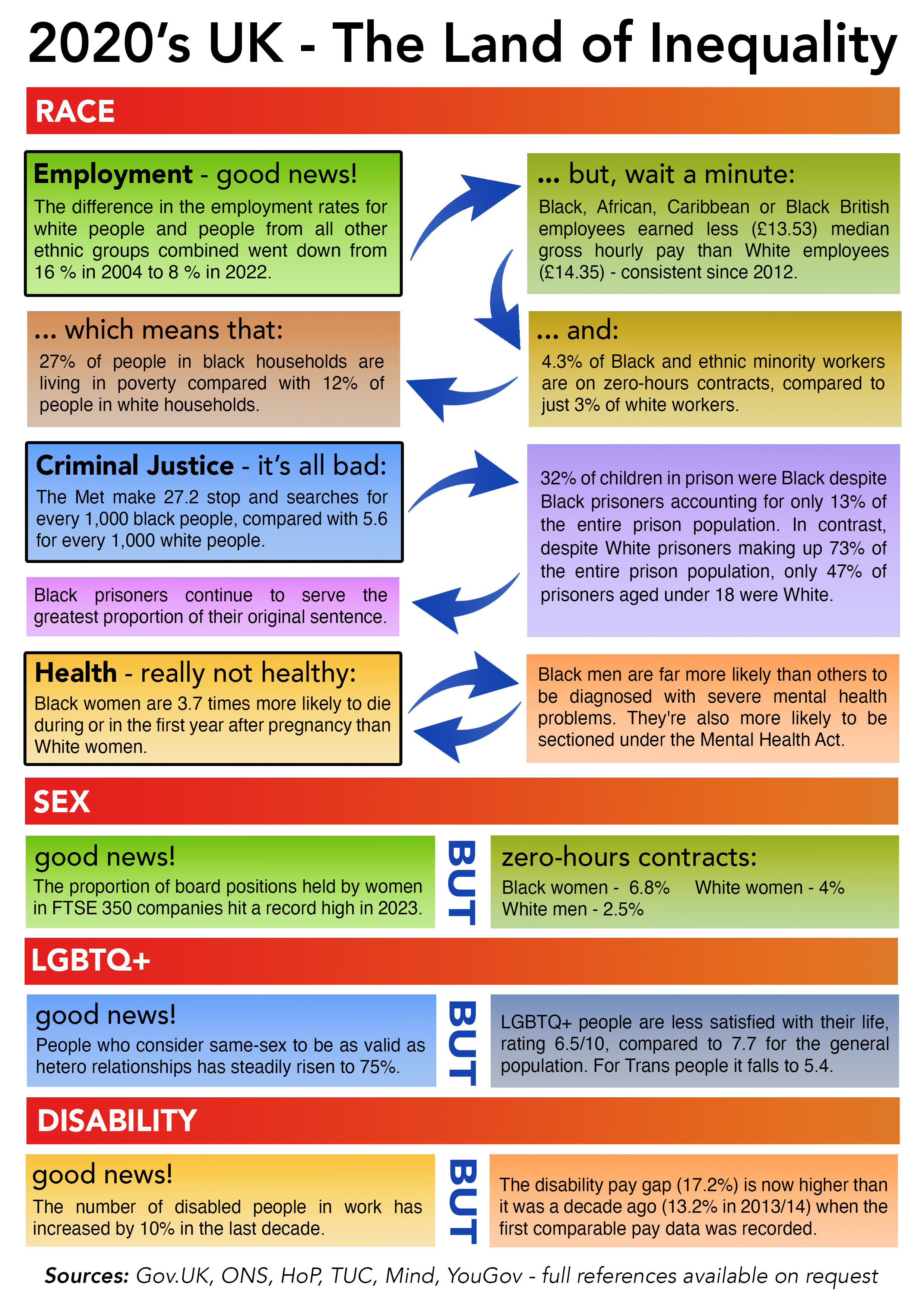
I’ll also illustrate the picture in workplaces with a few startling facts:
Research by TUC, Randstad, Deloitte – 2022/23
Astonishing! After all that awareness-raising training, such little progress in establishing equity, justice and decency in the workplace. Sure, things may have improved in workplaces since the 1970s, but we must ask why progress has been so slow.
Why has all this effort and money produced such little progress?
All the focus has been on ‘training’ staff, on awareness raising and information giving, while the fundamental organisational structures and power dynamics have remained largely untouched. Not only does this produce little progress towards equity, it creates hopelessness and cynicism. Head banging and brick walls wear down even those who are most committed to change.
I have had this confirmed over and over again during my years as an EDI trainer. I’ve seen how it goes: I do some EDI sessions for staff, they find them really interesting and enjoyable, some of them are even inspired to become active inclusion advocates. But then the barriers kick in – “not enough time”, “no resources”, “that’s not how we do things here”. Disappointment and inertia take over and nothing changes – worse, the feeling that there’s no point, makes future change even less likely.
I won’t do ‘tick box’ EDI work like this any longer. I’m dedicating my work to creating real change and I can tell you that it means STARTING AT THE VERY TOP! I believe we must direct more energy to changing the structural base of organisations, rather than the awareness of the staff. If we can, then more inclusive behaviours and attitudes will follow, baked in, part of the culture.
And this means going to the people at the very top – CEOs, MDs, Boards, etc. – those who hold the power to change the way things are organised and done (and the keys to the bank vault to fund it!) This can be difficult as, in my experience, there is often a great deal of resistance from this quarter.
It's time to start knocking at the boss’s door more persistently, and I’ve been developing a ‘Coaching For Inclusion’ programme to encourage them to open it. You can see the programme for yourself: www.activelearningteam.com/coaching
But here, I want to explain the principles that underpin it.
Thus, the second principle:
Why is this broad understanding of Diversity so important?
Now it becomes personal, for everyone. There’s motivation to take the knowledge and turn it into everyday actions. If this culture is nurtured and sustained, it can change everything in the workplace, opening minds and hearts, reducing conflict, rewarding innovation and participation.
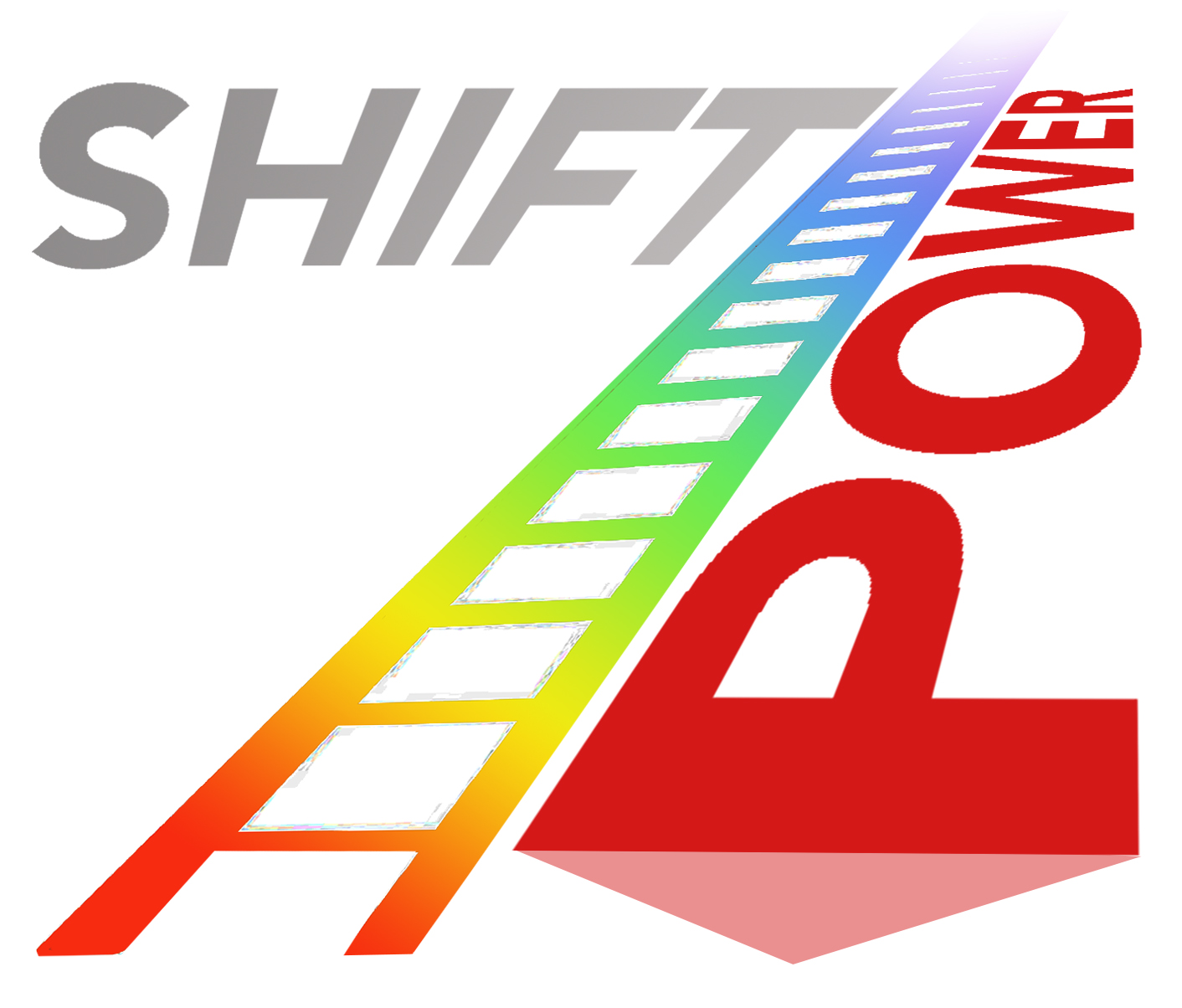
Two definitions of the word ‘Power’:
Too many managers think their job is about No.1. The best leaders know where the real power (No.2) lies – in the energy, knowledge and commitment of ‘ordinary’ staff; they are the real driving force for the machine. The leader’s job is to facilitate that energy.
This is why we need to shift power - from ‘control and influence’, which shuts down diversity and moulds individuals into the manager’s or organisation’s way of thinking and doing, to facilitating energy, which opens-up the power of diversity.
Now, back to the Protected Characteristics. I hope it doesn't sound like I am diminishing the importance of these. They are very important because they are the characteristics that are most likely to attract discrimination in work and society. But I have seen how those organisations that focus only on their diversity data and increasing representation, often do manage to recruit a few more disabled people, people of colour, women / men, LGBTQ+ people, people of different faiths, only to have them leave within a year. Why? Because they had not built an inclusive culture for everyone. A few sessions on disability awareness cannot substitute for an embedded culture that allows staff to be open to difference, willing to face and address their own biases (conscious and unconscious) and, above all, feel safe to learn from one another.
And once we’ve got senior leaders onboard with these principles, sanctioning the necessary structural changes, role modelling inclusive approaches, then it’s time to train staff – not in the facts of the Equality Act but in the everyday inclusive habits that can unleash the power in the diversity of their teams.
You can see my staff development programmes here:
https://www.activelearningteam.com/copy-of-our-training
Coaching For Inclusion for senior leaders:
https://www.activelearningteam.com/coaching-for-inclusion
If you’d like to read more on my approach to EDI read my blog posts:
https://www.activelearningteam.com/blog/categories/category-1
I have dedicated my adult life to assisting others in learning and in improving their lives, across a diverse range of people: from ‘lifers’ in prison, to CEOs of major companies. My ability to…